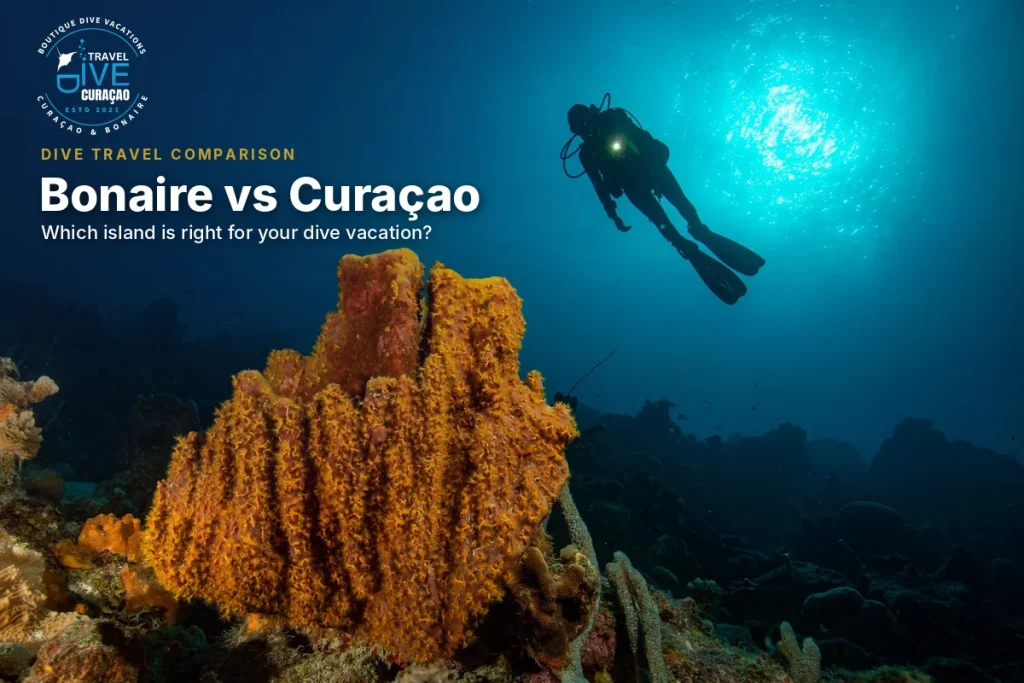
Bonaire vs Curaçao for scuba diving comes down to how you like to dive. Bonaire is the purer shore diving island: its entire coastline is a protected marine park, more than 60 marked sites are reachable straight from the road, and the island runs on dive-whenever-you-like freedom. Curaçao balances shore and boat diving, with over 38 shore diving and snorkeling sites among more than 70 dive sites, steeper wall topography, the Superior Producer wreck, and far more to do above the water. Independent shore divers often lean Bonaire, mixed groups and families often lean Curaçao, and many of our guests simply dive both.
We are Dive Travel Curaçao, a local dive travel team based in Willemstad, and we plan vacations to both islands. That means we have no reason to oversell either one. This page is the honest side-by-side Bonaire vs Curaçao comparison. Once you know which island fits, every section points you to the detailed guide for your next step.
On this Page
Bonaire vs Curaçao at a Glance
When you compare Bonaire vs Curaçao, start with what they share. Both islands sit outside the main Atlantic hurricane belt, keep the water at roughly 26–29°C (79–84°F) all year, and regularly deliver 20–30 m (60–100 ft) of visibility. The differences are in style, not quality.
| Factor | Bonaire | Curaçao |
| Dive style | Independent shore diving first | Shore and boat diving in balance |
| Dive sites | 85+ numbered marine park sites, 60+ from shore | 70+ dive and snorkel sites, 38+ from shore |
| Boat diving | Klein Bonaire and the north coast | Remote walls, drifts, the east and west ends, and Klein Curaçao |
| Reef character | Gentle slopes, a double reef in the south, superb macro | Steeper walls, coral pinnacles, more varied topography |
| Signature wreck | Hilma Hooker (sank 1984) | Superior Producer (sank 1977, turns 50 in 2027) |
| Reef protection | Whole coastline a national marine park since 1979; Nature Fee required | Curaçao Marine Park in the east; active coral restoration island-wide |
| Above the water | Flamingos, national parks, windsurfing, quiet evenings | UNESCO-listed Willemstad, 30+ beaches, dining, festivals |
| Getting around | A pickup truck is essential | Optional on Sleep & Dive; a truck is best for shore diving |
| Island feel | About 288 km², compact and dive-centric | About 444 km², a larger island with distinct regions |
| Best for | Experienced independent divers, photographers, dive-first trips | Mixed groups, families, beginner to advanced divers who want variety |
Bonaire vs Curaçao Diving: How the Underwater Experience Compares
Ask divers who know both islands about Bonaire vs Curaçao diving and they will tell you the same fish live on both reefs. What changes is how you reach them, what the reef looks like when you arrive, and how much of your day revolves around diving.
Shore Diving: Total Freedom vs. Variety
Bonaire made shore diving famous. Painted yellow stones along the coastal road mark each site: park, gear up, walk in. The reef usually starts close to shore, many dive resorts sit on their own house reef, and you can dive at sunrise, at midday or after dark without asking anyone. Entries are often over ironshore and rock, so good booties and a check-out dive on day one are worth it.
Curaçao offers more than 70 dives site, of which 38 are shore diving and snorkeling sites along its sheltered south and west coasts. Many come with a sandy beach, an on-site dive shop and somewhere to eat lunch, which makes a shore dive feel like a beach day too. The swim to the drop-off is sometimes longer than on Bonaire, and the quiet Westpunt and Banda Abou coast is where independent shore divers spend most of their time. Our guide to shore diving in Curaçao covers the best entries.
| The edge: Bonaire for sheer volume and convenience of shore diving. Curaçao for shore dives that double as a beach day, with more variety from one site to the next. |

Boat Diving
On Curaçao, more than half of the underwater world is only reachable by boat: remote walls on the east end, current-swept drift dives at Watamula and Black Rock, and day trips to Klein Curaçao. If you like a mix of guided boat days and independent shore days, Curaçao gives you more of both. See our guides to boat diving in Curaçao and drift diving in Curaçao.
On Bonaire, boat diving is the complement rather than the core. The uninhabited island of Klein Bonaire, just across the bay from Kralendijk, has more than 20 boat sites with some of the healthiest coral in the marine park, and they make a superb break from shore days.
Reef Character and Topography
Bonaire’s reefs typically slope gently from the shallows before dropping away, and south of Kralendijk a double reef runs parallel to shore. Decades of protection show in the coral, and the calm, shallow terraces are made for slow, long dives.
Curaçao’s fringing reef runs close to shore before dropping into a wall, which gives it a more dramatic profile. Signature sites like the Mushroom Forest, the Blue Room sea cave and the remote east end show off a topography that changes noticeably from one region to the next. Our marine life in Curaçao guide has the month-by-month species calendar.
Wreck Diving: Superior Producer vs. Hilma Hooker
Each island has one headline wreck, and both are cargo ships resting at around 30 m (100 ft). Bonaire’s Hilma Hooker sank in 1984, lies on its side and is reached from shore. Curaçao’s Superior Producer sank just outside Willemstad harbor on September 30, 1977, sits upright, and is an Advanced Open Water dive where nitrox is recommended. It turns 50 on September 30, 2027, so read the full MV Superior Producer wreck history if you are planning around the anniversary.
Where Curaçao pulls ahead is range: shallow wrecks such as the Tugboat suit newer divers, and deeper wrecks challenge experienced ones. Our wreck diving in Curaçao guide covers every level.
Marine Life, Macro and Night Diving
Bonaire is a macro photographer’s playground, with seahorses, frogfish and nudibranchs on the reef and tarpon under the Salt Pier. Curaçao adds reliable sea turtle encounters at sites like Playa Lagun, eagle rays on the walls, and annual coral spawning on the nights after the late-summer full moons. On both islands, a night dive on a resort house reef you already know by day is one of the easiest and most rewarding dives you will ever do. Photographers can go deeper with our underwater photography in Curaçao guide.
Which Island Is Better for Your Experience Level?
Your certification level and comfort diving independently shape the Bonaire vs Curaçao decision more than anything else.
Newly Certified and Beginner Divers
Both islands are excellent places to build confidence, but they suit different styles. Curaçao gives newer divers more structure: a Sleep & Dive package pairs your resort with an on-site dive shop, guided boat dives and a calm house reef. Bonaire’s water is just as friendly, but its independent shore diving assumes you are comfortable planning your own dives, managing your gas and navigating back to your entry. Many newer divers start Bonaire with a few guided dives, and that is exactly the right instinct.
Intermediate and Advanced Open Water Divers
This is where both islands shine. Bonaire lets you log a high number of dives in a week and sharpen buoyancy and navigation on site after site. Curaçao opens up the Superior Producer, gentle drift dives and deeper walls, with guided boat days to stretch your skills safely.
Experienced and Independent Divers
If your ideal day is four or five shore dives on your own schedule, Bonaire’s dive-all-day culture is hard to beat. If you want independence plus variety, Curaçao’s west coast shore diving, combined with boat-only sites on the remote ends of the island, gives you a longer list of different dives.
Snorkelers
Snorkelers do well on both. Curaçao has sea turtles at Playa Lagun, beach-entry reefs all along the coast and Klein Curaçao day trips; read more about snorkeling in Curaçao. Bonaire has shallow reef tops at sites like Andrea I and II and No Name Beach on Klein Bonaire. Snorkelers on Bonaire need a valid marine park Nature Fee tag, just like divers.
| Dive safely on either island: do a check-out dive on your first day, carry a surface marker buoy on every shore dive, keep your profiles conservative on multi-dive days to reduce the risk of decompression sickness, and plan a full no-dive day before you fly. Both islands have a hyperbaric chamber, and we recommend arriving with DAN Europe dive medical insurance. |
Reef Conservation on Bonaire and Curaçao
Bonaire is the Caribbean’s original protected dive destination. The Bonaire National Marine Park, established in 1979 and managed by STINAPA, covers all waters around Bonaire and Klein Bonaire from the high-water mark to 60 m. Every diver and snorkeler pays a Nature Fee that funds rangers, mooring buoys and reef monitoring, and the Reef Renewal Foundation Bonaire runs coral nurseries inside the park. Current fees and rules are in our Bonaire Dive Vacation Guide.
Curaçao has no island-wide nature fee for divers, although some beach-access sites charge an entry or parking fee. Its reefs are protected through the Curaçao Marine Park on the east end and an active restoration community including Reef Renewal Curaçao, CARMABI and SECORE International. Dive Travel Curaçao donates 1% of net proceeds to Reef Renewal Curaçao, and you can join a nursery dive during your stay. Learn more about sustainable dive tourism in Curaçao.
On both islands the same habits matter most: good buoyancy, no touching, a reef-friendly mineral sunscreen, and ordering lionfish whenever it is on the menu.
Above the Water: Non-Divers, Culture and Pace
For many travelers, this is where Bonaire vs Curaçao is decided, especially when not everyone in the group dives.
Curaçao is the livelier island. UNESCO-listed Willemstad, with its colorful Punda waterfront and the Pietermaai and Otrobanda districts, gives you museums, street art, restaurants and nightlife. Add more than 30 beaches, national park hikes, Thursday-night Punda Vibes and a year-round festival calendar, and a non-diving partner or family has plenty to do. Our Curaçao Dive Travel Guide covers it all, and our list of top things to do in Curaçao is built for surface intervals and no-fly days.
Bonaire is quieter and nature-first. Expect flamingos at the southern salt flats, cactus-covered hills in Washington Slagbaai National Park, world-class windsurfing and mangrove kayaking at Lac Bay, and a small, friendly capital in Kralendijk. Evenings are relaxed and most visitors are in bed early for a sunrise dive. Our Bonaire Dive Vacation Guide covers the parks, food and non-diver activities.
| The edge: Curaçao for families, non-divers, food lovers and culture. Bonaire for nature, quiet and a vacation that revolves around the next dive. |
Getting There, Getting Around and Trip Style
Flights and Island Hopping
Curaçao International Airport (CUR) has the wider range of direct service from North America and Europe, and many Bonaire itineraries connect through Curaçao. The two islands are only about 74 km (46 miles) apart, a flight of roughly 25 to 30 minutes on small inter-island aircraft with strict baggage allowances, so tell us about your gear before you book.
Vehicles
On Bonaire, a pickup truck is part of the dive kit: sites are spread along the coast and many are reached on unpaved tracks. On Curaçao, a vehicle is optional on a resort-based Sleep & Dive package and essential for independent shore diving, which is why our Sleep, Drive & Dive packages include one. Compare options in our guide to car and truck rentals.
Where You Stay: Bonaire vs Curaçao
On Bonaire, we base guests at two trusted dive resorts near Kralendijk, Buddy Dive Resort and Grand Windsock Dive & Beach Resort, each with a house reef, a truck and unlimited air or nitrox. On Curaçao, you choose between three bases: the Mambo Beach and Willemstad coast for resort convenience, the Pietermaai District for culture, or the west coast for independent shore diving. Compare every property in our best dive resorts in Curaçao guide.
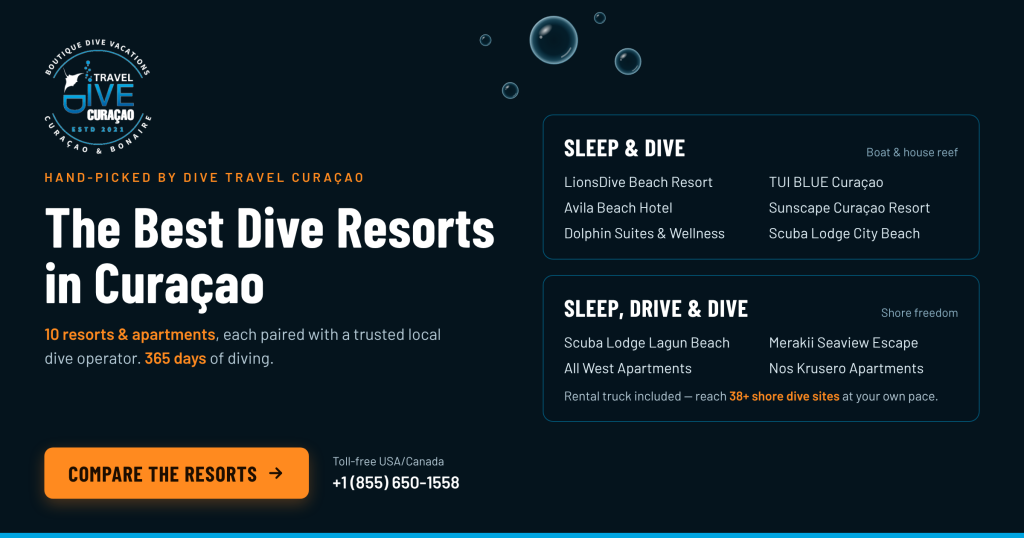
Entry Requirements and Cost
Curaçao asks visitors to complete a Digital Immigration Card before arrival. Bonaire requires a Visitor Entry Tax and the marine park Nature Fee, both paid online before you travel.
Neither island is automatically the cheaper one. What you pay depends on your travel dates, the property and room type, how many boat dives you book, whether you need a vehicle and how many people are sharing. Bonaire adds its two mandatory visitor fees, while on Curaçao guided boat diving costs more than independent shore diving. Because every trip we plan is custom, we price it on your actual dates and choices.
Bonaire vs Curaçao: Our Honest Recommendation
Choose Bonaire If You…
- Want to shore dive as often as you like, on your own schedule
- Are a confident, experienced diver happy to plan your own dives
- Love macro and underwater photography on calm, shallow reefs
- Prefer a quiet, nature-focused island where diving is the whole point
- Are traveling with other divers rather than non-divers
Next step: Explore our Bonaire scuba diving vacations, with Sleep, Drive & Dive packages at Buddy Dive Resort and Grand Windsock.
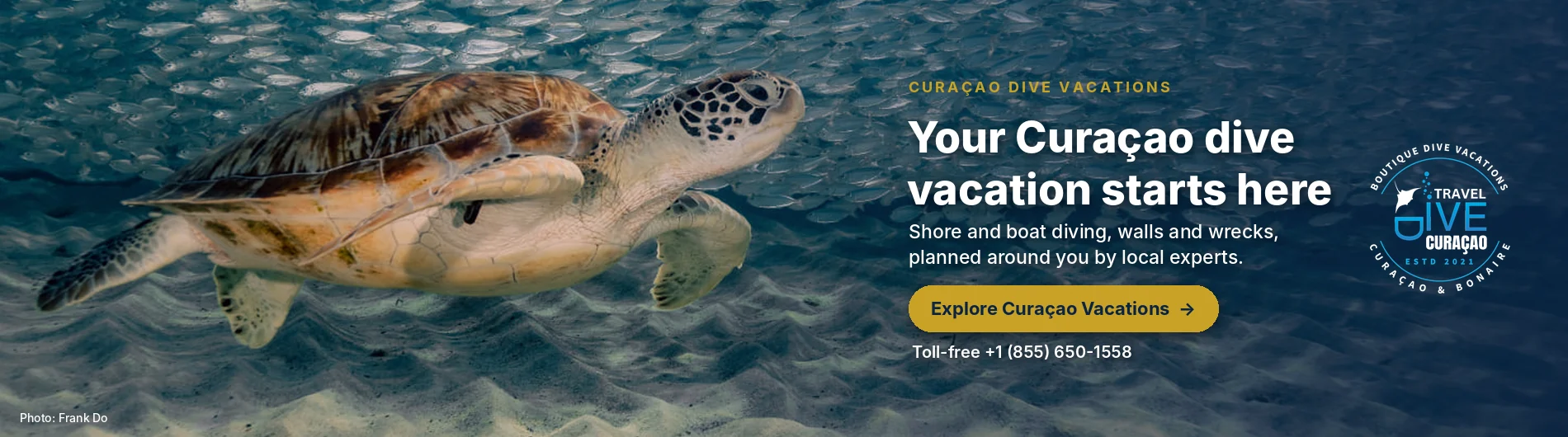
Choose Curaçao If You…
- Want the freedom of shore diving and the variety of boat diving in one trip
- Are a newer diver who would like guided dives and an on-site dive shop
- Want walls, drifts and wrecks for every certification level
- Are traveling with non-divers, kids or anyone who wants beaches, food and culture
- Like having a lively city, restaurants and festivals between dive days
Next step: Explore our Curaçao scuba diving vacations, from beachfront Sleep & Dive resorts to west coast Sleep, Drive & Dive apartments.
Choose Both If You…
- Have 10 days or more and want two different dive cultures in one vacation
- Are an experienced diver who wants Bonaire’s freedom and Curaçao’s variety
- Want to end a dive-heavy trip with a relaxed few days of culture and dining
Can’t Decide? Dive Both Islands in One Trip
The good news is that you do not have to settle Curaçao vs Bonaire at all. A twin-island trip is our most requested custom itinerary. Ten to fourteen days works best, typically seven nights in Curaçao and five to seven in Bonaire.
Many divers start in Bonaire for the most intensive diving and finish in Curaçao, where Willemstad’s culture and restaurants make the no-dive day before your flight home easy to enjoy. Others start in Curaçao to settle in with guided dives before switching to Bonaire’s independent shore diving. We build both halves as one itinerary and schedule a no-dive buffer before the inter-island flight, following the same flying-after-diving guidance you use for the flight home.
For the planning details, see how Dive Travel Curaçao builds twin-island trips and the “Adding Bonaire” section of our Curaçao Dive Travel Guide.
Plan Your Next Step
This Bonaire vs Curaçao comparison helps you choose. These guides help you plan:
| Your next question | Read this guide |
| How does a custom dive vacation to either island work? | Dive Travel Curaçao |
| I’ve chosen Curaçao. What are my resort and package options? | Curaçao Scuba Diving Vacations |
| What should I know before I travel to Curaçao? | Curaçao Dive Travel Guide |
| I’ve chosen Bonaire. Where do I stay and dive? | Bonaire Scuba Diving Vacations |
| What are Bonaire’s dive sites, fees and marine park rules? | Bonaire Dive Vacation Guide |
| Thinking about Aruba too? | ABC Islands Guide · Aruba vs. Curaçao |
Bonaire vs Curaçao FAQ
Is Bonaire or Curaçao better for scuba diving?
Neither is better overall; they suit different divers. Bonaire is best for independent shore diving inside a protected marine park, with more than 60 sites reachable from shore. Curaçao is best for variety, combining over 38 shore diving and snorkeling sites with boat-only walls, drift dives and wrecks for every certification level.
Which island has better shore diving, Bonaire or Curaçao?
Bonaire is widely regarded as the shore diving capital of the world, with yellow stones marking more than 60 shore sites and the reef starting close to the entry. Curaçao also offers excellent shore diving, often from beaches with facilities, but the swim to the drop-off can be longer.
Is Bonaire or Curaçao better for beginner divers?
Both have calm, warm, clear water. Curaçao is usually the easier choice for newer divers who want guided boat dives and an on-site dive shop at their resort. Bonaire suits newer divers who are comfortable planning their own shore dives, ideally after a few guided dives.
Which island is better for non-divers and families?
Curaçao, in most cases. It offers UNESCO-listed Willemstad, more than 30 beaches, a wide restaurant scene and year-round festivals. Bonaire suits nature lovers who enjoy flamingos, national parks, windsurfing and kayaking, and a quiet pace.
How far apart are Bonaire and Curaçao?
Bonaire and Curaçao are about 74 km (46 miles) apart. The inter-island flight takes roughly 25 to 30 minutes on small aircraft with strict baggage allowances, so plan how you will travel with your dive gear.
Can I dive Bonaire and Curaçao in one trip?
Yes. A twin-island trip of 10 to 14 days works best, typically seven nights in Curaçao and five to seven in Bonaire. Schedule a no-dive buffer before the inter-island flight and a full no-dive day before your flight home.
Do I need a car in Bonaire and Curaçao?
In Bonaire, a pickup truck is essentially a must for shore diving. In Curaçao, a vehicle is optional on a resort-based Sleep & Dive package with boat diving, and strongly recommended for independent shore diving.
Curaçao vs Bonaire: which island has better wreck diving?
Each has a headline wreck at about 30 m (100 ft): the Hilma Hooker in Bonaire and the Superior Producer in Curaçao, which turns 50 on September 30, 2027. Curaçao offers more wreck variety overall, from shallow sites like the Tugboat to deeper dives.
Are Bonaire and Curaçao affected by hurricanes?
Both islands lie outside the main Atlantic hurricane belt, so diving is possible every month of the year. December to April is peak season on both islands and books up first.
Is Bonaire or Curaçao more expensive for a dive vacation?
Neither is automatically cheaper. Cost depends on travel dates, accommodation, the number of boat dives, vehicle rental and group size. Bonaire adds a mandatory Visitor Entry Tax and marine park Nature Fee, while guided boat diving in Curaçao costs more than shore diving.
Plan Your Bonaire or Curaçao Dive Vacation with Local Experts
Still weighing Bonaire vs Curaçao? Tell us how you like to dive, who is coming with you and when you can travel, and our reservations team will recommend the right island, or the right split between both, and build the trip around you. Read what past guests say in our dive vacation reviews, or see how our customized dive vacations and group dive travel come together.
| Our team at Dive Travel Curaçao can personalize this vacation for you. Send us your travel dates, number of travelers, certification levels, how many people dive, your preferred dive style and a budget range. Email reservations@divecuracao.info | Toll-free USA/Canada +1 (855) 650-1558 | Curaçao / WhatsApp +599 9 699 5297 Contact our reservations team · Read the planning guide |
Header image by Frank Do